Description
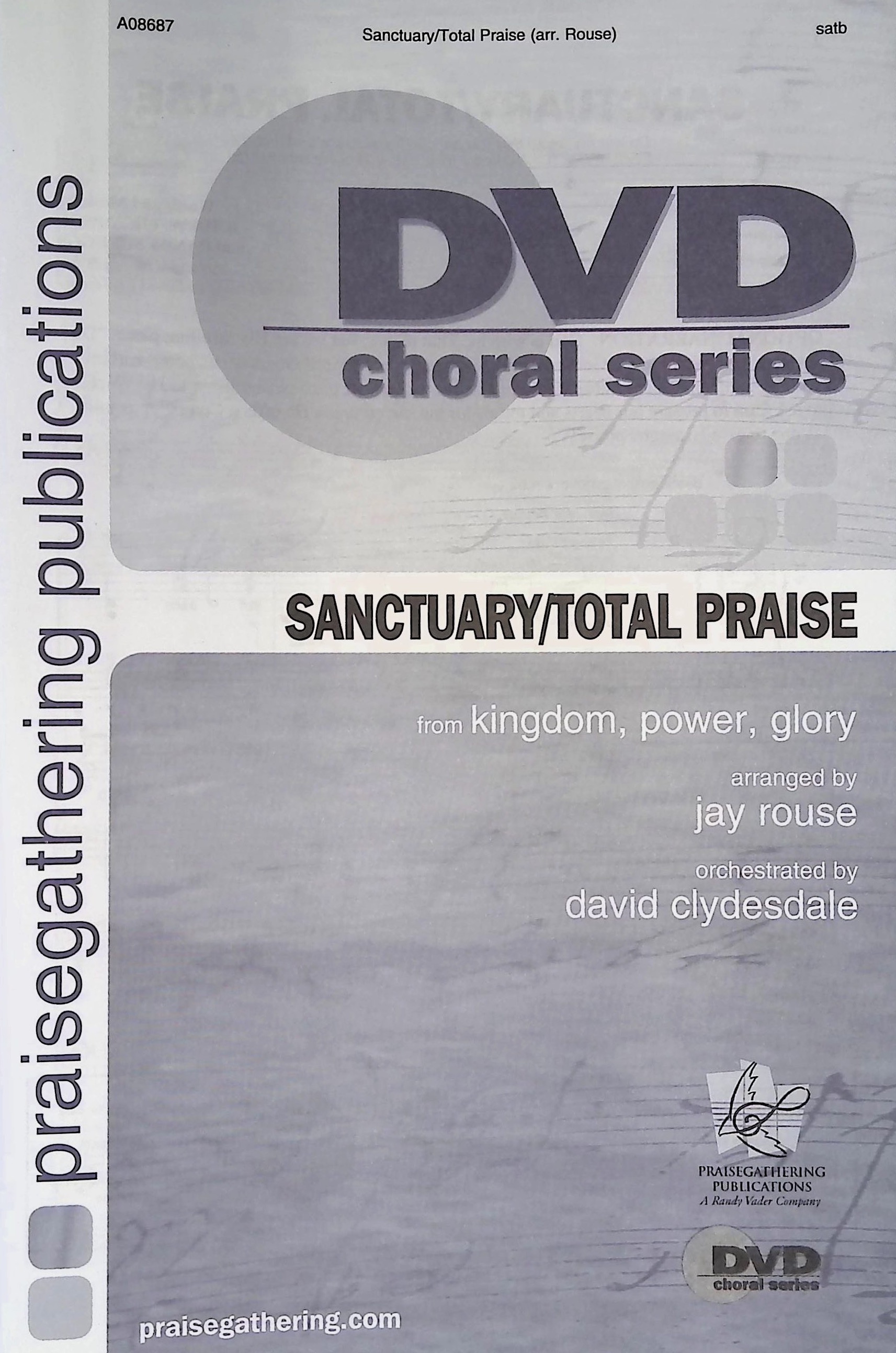
A great arrangement for worship gatherings set for orchestra and SATB choir. This is a moderately easy composition arranged by Jay Rouse that is perfectly suited for your upcoming church service or special service event.
SCORE SPOTLIGHT: SANCTUARY/TOTAL PRAISE
Sanctuary by John W. Thompson and Randy Scruggs
Total Praise by Richard Smallwood
Arranged by Jay Rouse
Orchestrated by David Clydesdale
Distinctive Insight
The sanctuary God desires is not a building but a people, and praise is where He makes His home.
Many worship anthems speak about entering God’s presence. Sanctuary/Total Praise reverses the picture. Drawing on 1 Corinthians 6:19, the medley begins with the truth that God’s presence enters us. The believer becomes the dwelling place. Praise becomes the address. That reversal gives this familiar pairing its theological weight and its emotional power.
Primary Hook
God does not visit our worship. He inhabits it.
Visual Hook
A church choir with lifted hands in a sun-filled sanctuary, morning light pouring through the windows onto the singers, suggesting that the true dwelling place of God is His people.
Two Songs, One Truth
Some songs belong to a single congregation. Others belong to the whole church. Sanctuary and Total Praise are both songs of the second kind. One emerged as a simple, prayerful chorus of consecration. The other became one of the most beloved declarations of trust in modern gospel music. Jay Rouse’s medley joins them into a single journey, and the optional narration printed in the score names the thread that ties them together: God is with us. He inhabits us. He inhabits our praise.
That is the logic of the medley. The first song asks God to make the singer a dwelling place. The second song shows what a life sounds like once He has moved in.
The Prayer That Begins It
The arrangement opens in D major with a relaxed gospel groove marked at quarter note equals 62, with the direction Black gospel groove setting the style from the first measure. Over that warm foundation, the choir and worship leader enter with the familiar prayer of consecration, marked with heart. The text asks God to shape the singer into something pure, holy, tried, and true, offered with thanksgiving.
This opening section is intentionally accessible. The melody is one most congregations already carry in their memory, and the writing allows the choir to sing it with tenderness rather than effort. A modulation from D major to E flat lifts the prayer for its second statement, giving the section a sense of rising sincerity without adding difficulty.
From Consecration To Confidence
A brief instrumental transition, marked a little faster, carries the music from prayer into proclamation. When Total Praise arrives, the key settles into C major at quarter note equals 60, and the emotional center of the medley shifts. The singer who asked to become God’s sanctuary now lifts eyes to the hills, confident that help comes from the Lord.
The genius of the pairing becomes clear here. Consecration is not an end in itself. The prayer of the first song is answered in the confidence of the second. Because God inhabits His people, His people can stand in the time of the storm.
The Storm And The Strength
Richard Smallwood’s text does not pretend that the life of faith is calm. It names the storm directly. But it names something greater than the storm: the God who is the source of strength and the strength of life itself. The choir declares that truth in bold, marked Big, with the full weight of the harmony behind it.
The arrangement honors the original’s dramatic architecture. The declaration rises, modulates from C into D flat, and gathers intensity with each return. Hands are lifted. Praise becomes total, holding nothing back.
The Amens
Then comes the moment choirs and congregations wait for: the extended amen sequence. Wave after wave of amens build through shifting harmonies and overlapping voice parts, with brief divisi adding richness to the texture. A molto ritardando gathers the voices for a suspended moment before the final a tempo release, and the medley closes with a triumphant return to D major at fortissimo, ending in full voice.
For many singers, this coda is the spiritual high point of the piece. It is praise that has run out of sentences and keeps singing anyway.
Why Conductors Will Appreciate This Piece
Jay Rouse’s setting is practical as well as powerful. The voicing is straightforward SATB with a worship leader role, and the divisi moments are brief and intuitive. The gospel groove is clearly notated, the modulations are well prepared, and the structure gives directors natural places to shape dynamics and pacing.
The optional narration provides a ready-made worship moment that frames the medley theologically before a note is sung. The supporting products listed in the score, including CD and DVD accompaniment trax, an anthem stem mix, and David Clydesdale’s full orchestration, allow the piece to scale from piano-led worship to a full orchestral presentation.
Most importantly, both songs are already loved. Rehearsal time goes toward expression rather than note learning, and congregations connect immediately.
A Medley With A Message
Medleys can sometimes feel like convenience, two songs joined because they share a key or a tempo. Sanctuary/Total Praise is joined by an idea. The first song is the prayer. The second song is the result. Together they trace the full movement of worship: God makes His home in His people, and His people respond with praise that holds nothing back.
Why This Piece Resonates
The medley resonates because it joins familiarity with depth. Congregations recognize both melodies within seconds, and that recognition opens the door for the message to land. The quiet consecration of the opening gives worshipers words for surrender. The confident climb of the second half gives them words for trust. And the amens give them a place to stand when words run out.
Few pairings move so naturally from stillness to celebration, and few endings send a congregation out with more joy.
Why Sanctuary/Total Praise Matters For Your Church
Most worship music describes praise as something we send up to God. Sanctuary/Total Praise presents praise as somewhere God lives.
By joining a prayer of consecration with a declaration of total trust, the medley traces the whole shape of the worshiping life: God makes His home in His people, and His people answer with praise that withstands the storm. The familiar melodies make the piece immediately accessible, while the theological thread, God inhabiting His people and their praise, gives it lasting substance.
For choirs seeking a piece that is easy to learn, rich to sing, and unforgettable to end a service with, this medley delivers on every count.
Additional information
| Catalog # | A08687 |
|---|---|
| Voicing | |
| Composers | |
| Arrangers | |
| Authors | |
| Accompaniment | |
| Release Date | |
| Content | |
| Season | |
| Difficulty | |
| Publisher | |
| Editor | Executive Producers: Randy Vader and Rose Aspinall Produced by Jay Rouse |
| Status |
You May Also Like...